The D♯ minor scale
The D♯ minor scale (natural minor) is D♯, E♯, F♯, G♯, A♯, B and C♯. Every natural minor scale climbs in the same steps: whole, half, whole, whole, half, whole, whole.

Two variations are common in D♯ minor:
- Harmonic minor: D♯, E♯, F♯, G♯, A♯, B and C𝄪. The 7th is raised to C𝄪, which gives the scale its pull back to D♯.
- Melodic minor: D♯, E♯, F♯, G♯, A♯, B♯ and C𝄪. The 6th and 7th are both raised (B♯ and C𝄪) going up; classical players come down on the natural minor.
Chords in D♯ minor
Build a chord on each note of the scale, using only notes from the key, and you get the seven chords of D♯ minor:
D♯m, G♯m and A♯m are the minor chords; F♯, B and C♯ are the major ones. Many songs in D♯ minor swap A♯m for A♯ (A♯, C𝄪 and E♯), the major V from the harmonic minor, because it leads home to D♯m more strongly.
With a 7th added, the chords become:
9th, 11th and 13th chords in D♯ minor
Stack more notes from the key on top of the 7ths and you get the lush chords of neo-soul, R&B and lo-fi. These are the ones that sound good in D♯ minor; the rest clash.
Chords from outside D♯ minor
Songs often borrow a chord from outside the key for color. G♯ and E♭ come from E♭ major, and E, half a step above home, is the dark sound of drill and trap. E♭7 and F7 are secondary dominants: 7th chords that pull hard toward one of the key's own chords.
Tap one to hear it pull back into D♯ minor.
Chord progressions in D♯ minor
Eight progressions that sound like D♯ minor, from pop to lo-fi. Play one, or tap any chord on this page to build your own and download it as MIDI.
The modern minor pop loop
The epic rise: two steps up to home
Two lush chords on repeat, under countless beats
Half a step up and back: the dark loop of drill
The major V pulls hardest back home
The walk down, from flamenco to rock
The major IV, borrowed: the bright minor vamp of funk
The minor ii–V–i, the jazz way home
D♯ minor key signature
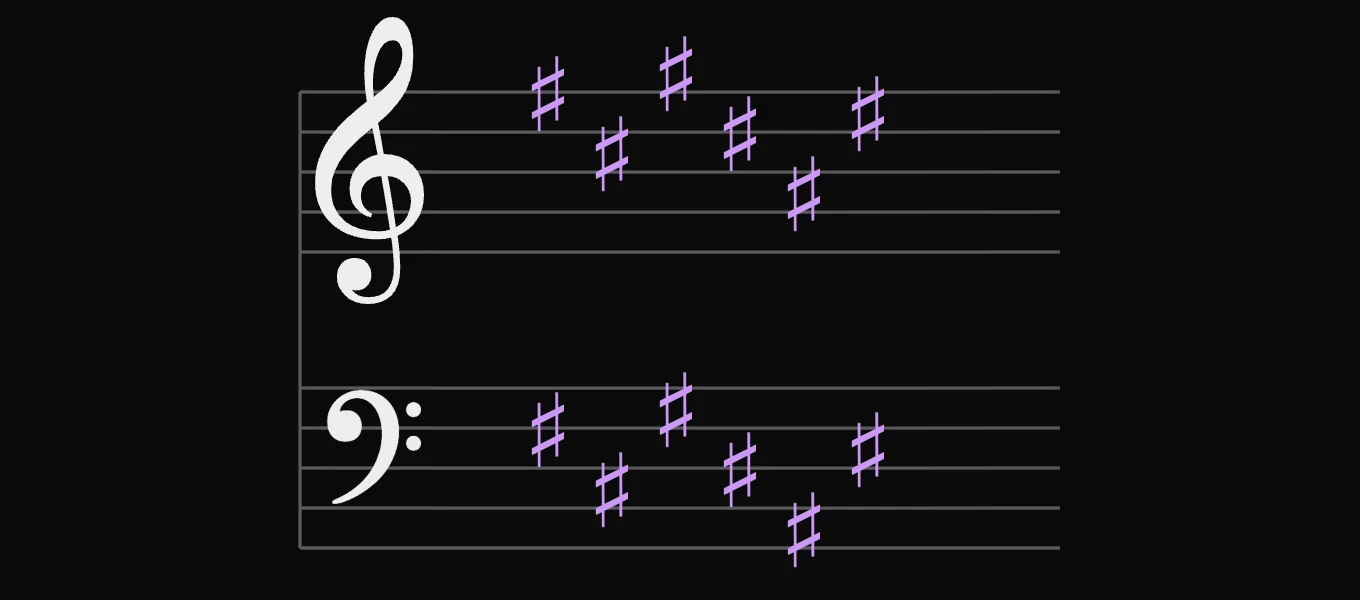
D♯ minor has 6 sharps: F♯, C♯, G♯, D♯, A♯ and E♯. They're written in that order at the start of every line of music, so every F, C, G, D, A and E is played sharp unless the music says otherwise.
Keys related to D♯ minor
- Relative major: F♯ major. It uses exactly the same notes, starting from F♯. Songs move between the two easily, and key finders often mix them up.
- Parallel major: E♭ major. D♯ major would need double sharps, so it's written as E♭ major (3 flats), which sounds the same.
- Next door on the circle of fifths: A♯ minor (7 sharps) and G♯ minor (5 sharps). Each shares all but one note with D♯ minor, so a song can move there smoothly.
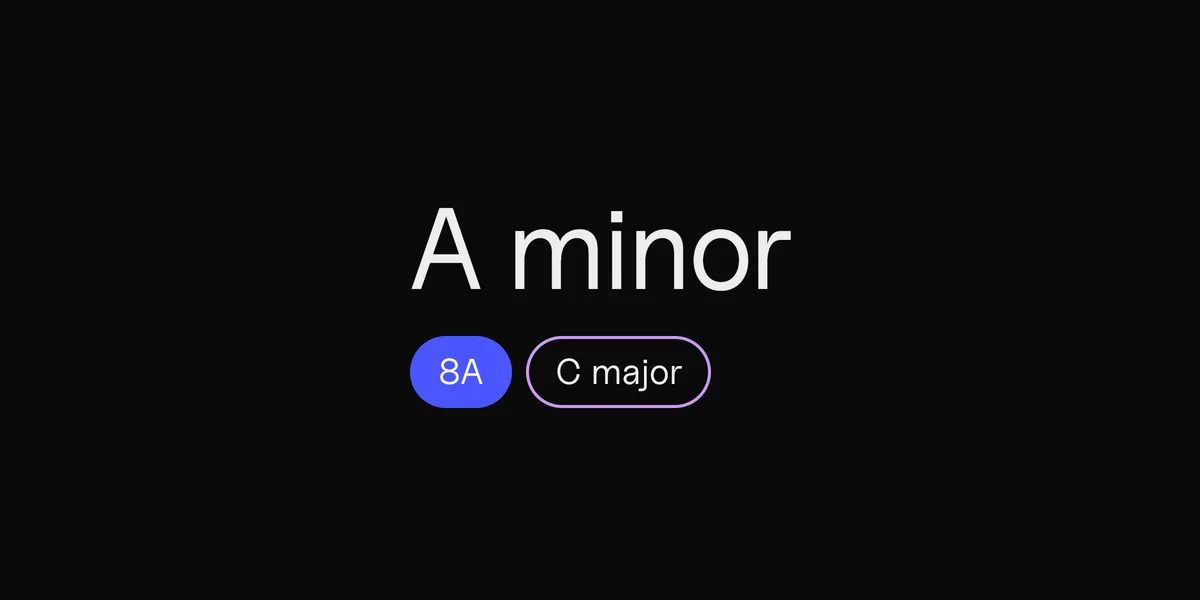
D♯ minor in Camelot: 2A
DJs use the Camelot wheel to mix in key. D♯ minor is 2A. It mixes smoothly with 1A and 3A (one step around the wheel) and with 2B (F♯ major, the same notes). See the Camelot wheel.
D♯ minor or E♭ minor?
D♯ minor sounds exactly like E♭ minor: the same keys on the piano, spelled with 6 sharps instead of 6 flats. Music is usually written in whichever spelling is easier to read.
What key is your song in?
Drop a song into our free key finder to see its key and Camelot code, or record anything your Mac plays with DOT and get its key, tempo and chords, saved as MIDI for your DAW.
Song not on your computer? DOT reads it while it plays.
Questions
What notes are in D♯ minor?
D♯, E♯, F♯, G♯, A♯, B and C♯.
What are the most popular chord progressions in D♯ minor?
i–VI–III–VII (D♯m B F♯ C♯); VI–VII–i (B C♯ D♯m); i9–iv9 (D♯m9 G♯m9).
What chords are in D♯ minor?
D♯m, E♯°, F♯, G♯m, A♯m, B and C♯, plus A♯ as the major V.
How many sharps are in D♯ minor?
6 sharps: F♯, C♯, G♯, D♯, A♯ and E♯.
What is the relative major of D♯ minor?
F♯ major. It has the same notes and the same key signature.
What is D♯ minor in Camelot?
2A.
Is D♯ minor the same as E♭ minor?
They sound the same and use the same piano keys; only the spelling differs (6 sharps against 6 flats).
Piano: Salamander Grand Piano, CC BY 3.0
 DOT7 min read
 Clips8 min read