What song structure is
Song structure, or song form, is the order of a song’s parts, and each part has a job. The verse tells the story, the chorus says the main idea and repeats it, and the bridge brings something new before the end.
Songwriters write the structure down as a map: Intro, Verse 1, Chorus, Verse 2, Chorus, Bridge, Chorus, Outro. The short way uses letters. The same letter means the same music, so that song is ABABCB, with the intro and outro left out.

The parts of a song
| Part | What it does | Usual length |
|---|---|---|
| Intro | Sets the sound before the voice. Often short, or skipped | 0 to 8 bars |
| Verse | Tells the story, with new words over the same music | 8 or 16 bars |
| Pre-chorus | Builds toward the chorus | 4 or 8 bars |
| Chorus | The main idea and title, the same every time | 8 or 16 bars |
| Post-chorus | A short tag after the chorus, like a chant or a riff | 4 or 8 bars |
| Bridge | Something new near the end | 4 or 8 bars |
| Outro | Ends the song with a repeat or a fade | 4 to 8 bars |
The hook isn’t a part
The hook is the catchiest bit of a song, whether a line, a melody, a riff or a sound. It usually sits in the chorus, often on the title. It can also be the intro’s riff or a post-chorus chant. In hip-hop, people often say “hook” to mean the chorus itself.
Song structure examples: the common forms
A form is a map that many songs share. Each row below is one form, part by part. The wider the block, the longer the part.

- Verse-pre-chorus-chorus is much of today’s pop. The map above is 96 bars, or 3:12 at 120 BPM.
- Verse-chorus is rock, country and a lot of pop, with a bridge or solo before the last chorus.
- Hip-hop runs 16-bar verses between hooks. Many songs open on the hook.
- In electronic dance music the drop takes the chorus’s place. Parts come in 8, 16 or 32 bars, so they’re easy to mix.
- AABA, or 32-bar form, is four 8-bar parts, with B as the bridge, the “middle eight”. “Over the Rainbow” is the classic example.
- Verses only (AAA) has no chorus at all. Folk songs and hymns often work this way.
“I usually start with a verse, but I try to get to the chorus as soon as I can, because if you don’t have a chorus, you don’t have a song. And I love writing choruses.”
Kai Williams, music artist and creator of Clips
How long each part lasts in seconds
Bars turn into seconds through the tempo. In 4/4 time a bar has 4 beats, so:
Seconds = bars × 4 × 60 ÷ BPM
| 90 BPM | 120 BPM | 140 BPM | |
|---|---|---|---|
| 4 bars | 10.7 s | 8 s | 6.9 s |
| 8 bars | 21.3 s | 16 s | 13.7 s |
| 16 bars | 42.7 s | 32 s | 27.4 s |
So a 16-bar rap verse at 90 BPM runs about 43 seconds, and an 8-bar chorus at 120 BPM runs 16.
Add the parts up and you get the song’s length. The pop map above is 96 bars. At 120 BPM a bar lasts 2 seconds, so the song runs 3:12. Its first chorus starts at 0:40, after 20 bars of intro, verse and pre-chorus.
If you don’t know the tempo, the free BPM finder reads it from your file.
How streaming changed song structure
Songs now get to the point faster. A study at Ohio State looked at US top-10 hits from 1986 to 2015. Intros that averaged more than 20 seconds in the mid-80s were down to about 5 seconds. The title, which the study counted as the first hook, also came about 18% sooner.
Streaming gives songwriters two reasons to hurry. Spotify counts a stream only after 30 seconds of play. And people skip fast. In 2014, Paul Lamere looked at billions of Spotify plays: about 24% were skipped in the first 5 seconds.
Whole songs are shorter too. In 2024 the average song on Spotify’s charts ran about 3 minutes, according to Chartmetric.
How to find the parts of your own song
By ear
Play the song and count the beats in fours: every 4 beats is a bar. Note the time wherever something changes: new chords, drums in or out, a new melody. Words that come back the same are the chorus. Music that comes back with new words is a verse.
In your DAW
In the app you recorded in (Logic, Ableton, GarageBand), open the session, or drop the bounce into a new project at the song’s tempo, so the bar lines match. The chorus is usually the widest, loudest block on the waveform, and it repeats. A bridge or a breakdown often thins out. Put a marker at each change and name it: Verse 1, Pre, Chorus.
With Clips
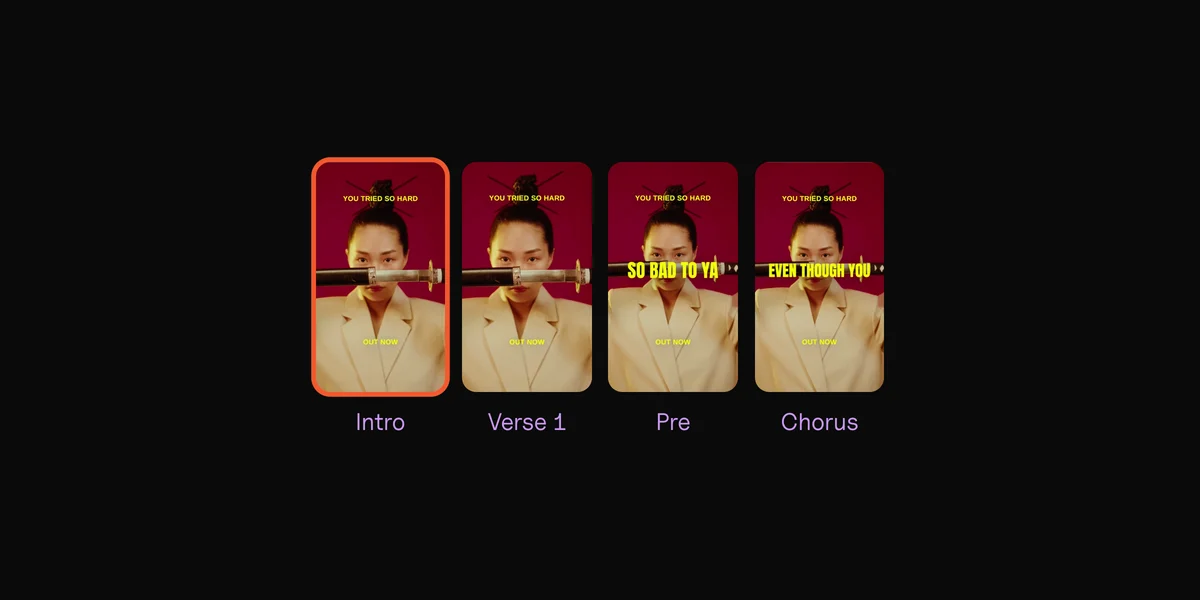
Drop the finished song into Clips, and it finds the tempo and the parts for you: intro, verses, pre-chorus, chorus, bridge and outro. Each part starts on a bar. If you hear a part differently, rename it, split it, or merge it with its neighbor.
Why the parts matter when you promote a song
A Reel, a TikTok or a short ad doesn’t play your whole song. It plays one part, often less: 15 seconds holds 4 bars at 90 BPM, or 8 bars at 140. So when you promote a song, you’re picking a part. Most artists pick the chorus.
That’s often the wrong guess. Kai Williams, who made Clips, ran ads for his song Bad to You. It has a long intro, then a verse, a chorus and a bridge. He ran the chorus for weeks at $0.63 a click to Spotify or Apple Music, then made a video for every part. The intro got the same click for $0.21, a third of the price.

The intro, the kind of part most new hits cut short, was the cheapest way to find listeners.
One test isn’t a rule, but it shows why you test. Someone scrolling decides fast, and you can’t know in advance which part makes them stop. Your song’s map is the list of parts to try. Make one short video per part, run them side by side for about a week, and put your money behind the cheapest clicks. How to promote a song with ads has the whole method, with budgets and the numbers to watch.
“That long intro set the vibe for the whole album, so I kept it long. I wanted the song to grow slowly. Bad to You was the first song I started writing for the album, thanks to that intro.”
Kai Williams, music artist and creator of Clips
Making those videos by hand means cutting the same song five or ten ways, on the beat. Clips does it in one go. It finds the parts, cuts a vertical video for each one on the beat, and syncs your lyrics word by word. The files come out named by part, ready to upload as separate ads.
Sources
5
- Has music streaming killed the instrumental intro?, Ohio State News, 2017
- How your streams are counted, Spotify for Artists
- The Skip, Paul Lamere, Music Machinery, 2014
- Why songs seem shorter, and why it's more complicated than you think, Chartmetric, 2025
- Thirty-two-bar form, Wikipedia

 Clips9 min read
 DOT8 min read